The monthly vs yearly IPTV subscription question usually gets settled by whoever advertises the biggest discount. That is the wrong way round, and it is why people end up paying for eleven months of something that stopped working in month four.
Monthly costs more per month and lets you leave. Yearly costs less per month and locks you in. Which one wins depends entirely on how much evidence you have about the provider, and most buyers decide long before they have any.
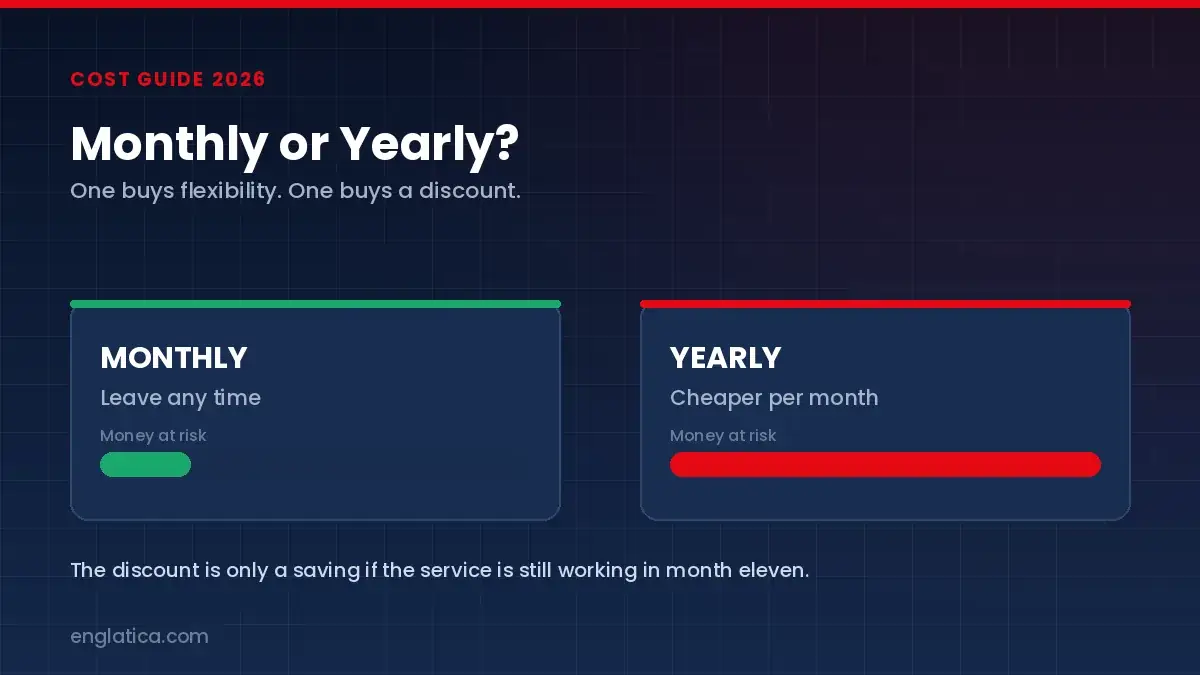
Quick Answer: Go monthly when the provider is new to you, when your viewing changes with the seasons, or when you are unsure. Consider yearly only after the service has survived several busy weekends and the discount still looks good once every extra fee is counted.
What Changes Between a Monthly and Yearly IPTV Subscription?
Monthly billing buys you an exit. Every thirty days you get to ask whether the channels, the price and the picture quality are still worth it. A yearly plan trades that exit for a lower effective monthly price, paid entirely up front.
| Factor | Monthly | Yearly |
|---|---|---|
| Upfront cost | Low | High |
| Effective monthly price | Higher | Usually lower |
| Money at risk if it fails | One month | Whatever is left of the year |
| Renewal attention | Frequent, hard to forget | Twelve months away, easy to forget |
| Best suited to | Testing, changing households | A service that already proved itself |
The discount is the part everyone looks at and the part that matters least. A cheap plan that stutters during the match you waited all week for is not cheap. It is a smaller amount of wasted money.
How Do You Work Out the Break-Even Month?
Divide the yearly price by the monthly price. The result is the month at which the annual plan starts costing less than paying month by month. If you will not realistically use the service that long, the discount loses money no matter how large it looks.
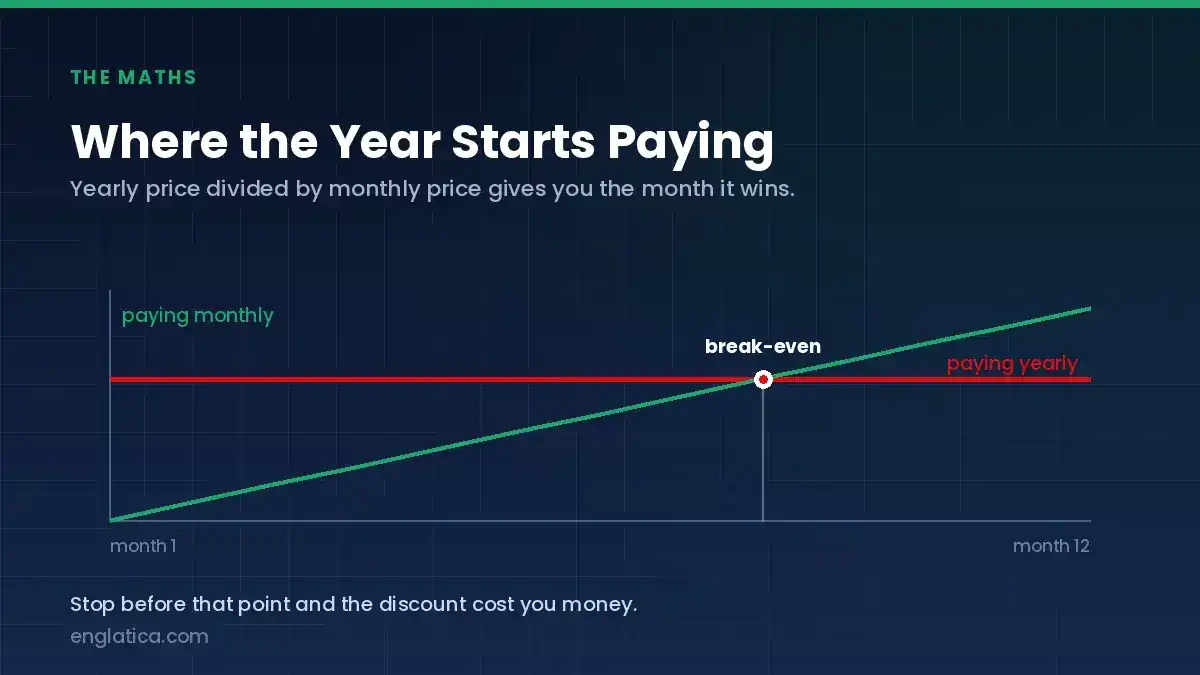
Take a plan at 15 monthly and 120 yearly. Twelve monthly payments come to 180, so the headline saving is 60. Now the second sum: 120 divided by 15 is eight. Eight months is the real threshold, and it is the same break-even calculation a business runs before any commitment.
Stop watching in month six and you handed the provider two months of free money. Watch the full year and you saved 60, assuming the service still works in month eleven. That assumption is the whole gamble.
One number worth writing down: twelve minus your break-even month tells you how many dead months you can absorb before the discount disappears entirely. Break even at eight, and four bad months wipe it out.
When Is Monthly the Better Choice?
Whenever you still have unanswered questions. A new provider, an unstable connection, a viewing schedule that follows the sports calendar, or a household that might drop the service by spring. In all of those cases flexibility is worth more than the discount, and it is not close.
- The provider is new to you. You are risking one month instead of twelve while you find out whether support answers on a Sunday.
- Your viewing changes. Seasons end, kids move out, holidays happen. Annual plans assume a household that never changes.
- Your connection is shaky. Fix that first. Paying for a year of the sharpest tier while the router is the bottleneck helps nobody.
- You want to be able to leave. Prices move, lineups change, apps stop being updated. Monthly means reacting in weeks.
Monthly is also the sensible step straight after a trial. A short trial catches obvious failures. One paid month catches the ones that only appear on a Saturday night when everyone in your timezone is streaming at once. Our seven-day service test covers exactly what to check during that month.
When Does a Yearly Plan Actually Earn Its Discount?
When the provider has already proved itself. That means months of stable playback at peak hours, a support reply you were happy with, terms you have read, and a saving that survives every extra fee. Miss one of those and the shorter term is still the right call.
- You tested the real channels.Your local feeds, your sport, your guide data. Not a screenshot.
- It held up at peak time.Weeknight evenings and live events, not a quiet Tuesday morning.
- Support answered you once already.Find out how help works before you urgently need it.
- The business is transparent.Contact details, terms, cancellation. All findable without digging.
- The saving survives the fees.Currency conversion and card charges have eaten smaller discounts than this one.
Fail any single item and I would stay monthly another cycle. There is one exception worth naming: a provider you have already used for a year or more, on a plan whose renewal price you can see in writing. At that point the year is not a gamble, it is admin you do once instead of twelve times.
Which Hidden Costs Eat the Saving?
The advertised prices are rarely what leaves your account. Player apps, extra simultaneous connections, activation charges, currency conversion and a broadband upgrade all appear after the decision. Add them to both columns or the comparison is meaningless.
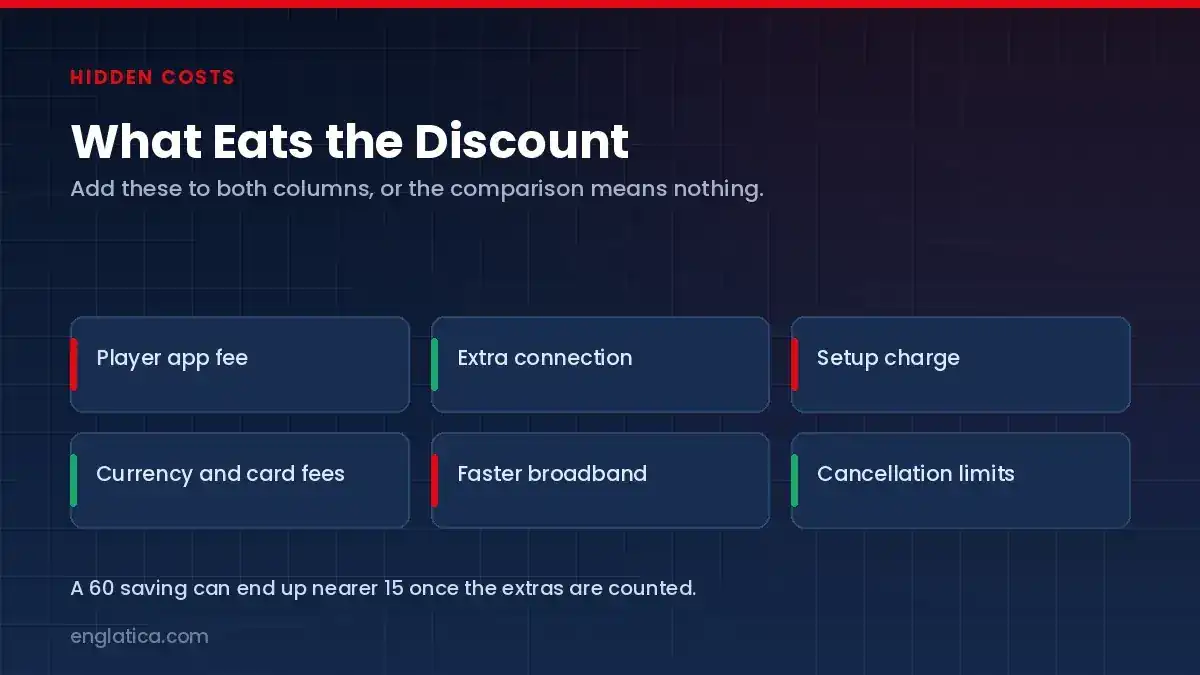
Here is how fast it moves. A yearly plan advertising a 60 saving, minus a 20 player licence, minus roughly 5 in currency and card fees, minus a second connection at 3 a month for the months you need it, is not saving 60 any more. It might be saving 15. Still a saving, but no longer a reason to hand over a year up front.
Renewal is the other quiet cost. A year is long enough that the charge arrives as a surprise, sometimes at a higher price than the promotional rate you signed up for. Write down the renewal date and the renewal price on day one, because you will not remember in month eleven.
What Is the Lowest-Risk Way to Subscribe?
Climb, do not jump. Start with a trial, move to one paid month, then a three to six month term if you are happy, and only then consider a full year. Each step costs slightly more and tells you considerably more, which is the trade you want.

Nobody has to follow this exactly. It just prevents the most common and most expensive mistake in this market, which is paying for twelve months because the discount looked good on day one.
Before comparing plan lengths at all, it helps to know what you are actually buying. Our breakdown of what IPTV services include separates live channels, on-demand, catch-up and guide data, and the channel list shows what your household would miss.
Monthly vs Yearly IPTV Subscription: Common Questions
Is monthly or yearly IPTV better in 2026?
Monthly is better for flexibility and testing. Yearly only wins once the provider has proven reliable and the annual saving still justifies the longer commitment after every fee is counted.
How do I calculate the yearly IPTV saving?
Multiply the monthly price by twelve, then subtract the annual price. Include setup, player, connection, currency and renewal costs on both sides before deciding anything.
When does a yearly IPTV plan break even?
Divide the annual price by the monthly price. The result is the number of months after which the annual plan starts costing less than paying month by month.
Should a first-time buyer choose a yearly plan?
Usually no. Start with a trial and one monthly term, then move to a longer plan only after testing channels, devices, support, billing and peak-time stability.
Can a yearly IPTV subscription auto-renew?
It can if the terms say so. Read the renewal date, price, notice period and cancellation method before paying, then save the receipt and the terms somewhere you will find them.
Is the cheapest yearly plan always the best value?
No. The saving disappears the moment the service becomes unreliable or the lineup changes. Value is price, reliability, support and flexibility together.
Choosing Between a Monthly and Yearly IPTV Subscription: The Short Version
Compare the same channels, the same connection count, the same fees and the same expected months of use. Anything else is guesswork dressed up as maths.
With a provider you have not used before, the order stays the same every time: trial, then a month, then longer. The discount can wait.
Test the service first. Work out the commitment second.
Start Your Free Trial