Basic cable cost in 2026 sits somewhere between $20 and $65 a month before a single fee lands on the bill, and the gap between those two numbers is the whole story. The cheapest tier is a legal requirement that providers barely advertise. The one on the website is a marketing package with a friendlier name and a much larger price.
Everything below was checked against US provider pricing in August 2026. All of it moves by street address, so read the numbers as the shape of the market rather than a quote for your house. What does not move is the fee stack, and that is where a $30 package quietly becomes a $60 bill.
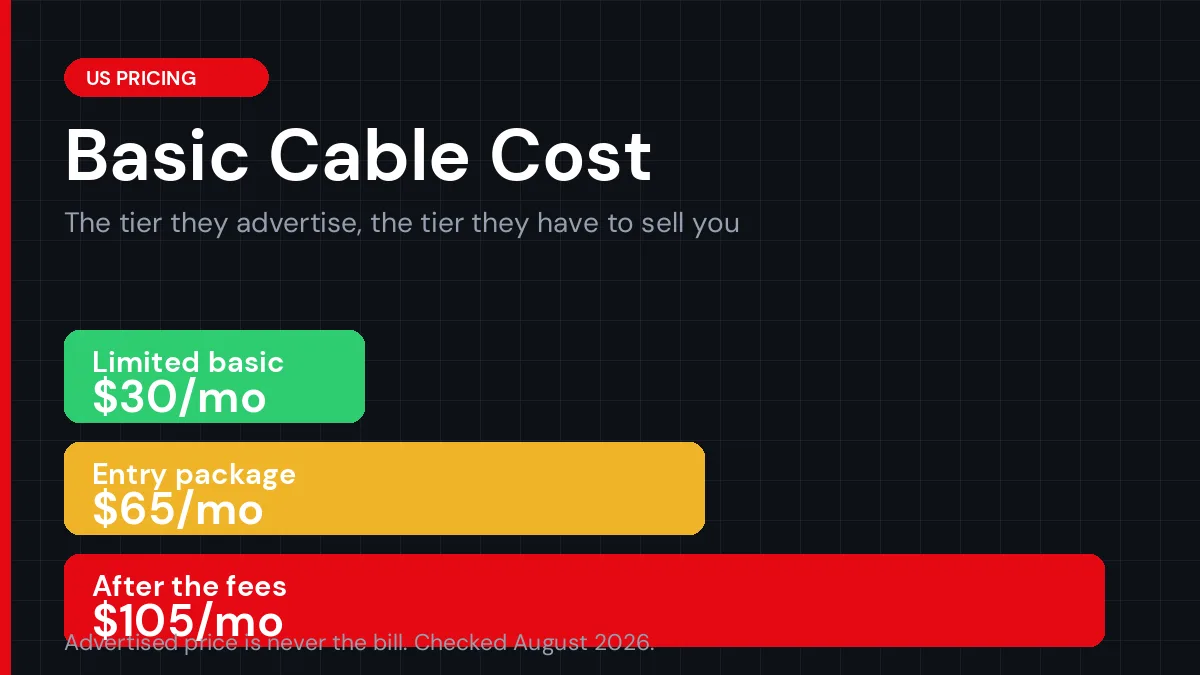
Quick Answer: Basic cable costs roughly $20 to $30 a month for the limited local-channel tier, and $55 to $65 for the entry packages providers actually promote. Add the broadcast TV surcharge, box rental and taxes and most households pay $25 to $40 more than the advertised price.
How much does basic cable cost in 2026?
Two prices exist. The limited local-channel tier runs about $20 to $30 a month, and the entry packages providers advertise run about $55 to $65. Fees then add $25 to $40 on top of either one. That is why the basic cable price you were quoted and the number on your statement never match.
The reason for the split is simple. Providers earn nothing on the cheap tier, so it does not appear in the package grid on their website. What appears instead is an entry bundle with 10 to 150 channels, sold as the starting point. It is the starting point of their catalogue, not of what you are allowed to buy.
For context, the average American pay TV household is now reported to spend somewhere around $128 a month once fees are counted. The whole point of shopping the basic tier is refusing to drift into that number by default.
The pressure behind those numbers is real. US cable lost millions of TV subscribers in a single recent year, and the households that stayed are carrying a larger share of the same fixed costs. Cheaper tiers do not get promoted in that situation, they get buried, which is precisely why the basic cable cost question is harder to answer than it should be.
What exactly is basic cable?
Basic cable is a legal category, not a marketing one. Under FCC rules, a cable system must offer a basic service tier to every subscriber before selling anything else, and that tier has to carry most local broadcast stations plus the public, educational and government channels named in its franchise agreement.
That single rule is worth more than any coupon. It means the cheap tier exists at every cable company in the country whether or not a sales page mentions it. It also means you can ask for it by its proper name, which changes the conversation from asking for a discount to asking for a product.
There is a second protection worth knowing. Your provider cannot force you onto a higher tier to buy premium channels or pay-per-view sold individually. If a representative tells you the movie channel requires the mid package, that is a sales position, not a rule.
- Names to use on the phone: basic service tier, limited basic, broadcast basic
- What it must include: local broadcast stations and the PEG access channels
- What it will not include: ESPN, Discovery, HGTV or anything else people think of as cable
- Rate review by your local franchising authority exists, but few still do it, so do not count on a capped price
Why hide a product you are required to sell? Margin. The limited tier carries local stations the operator already pays to retransmit, with no cable networks attached to mark up. Every incentive points at moving you one tier higher, and the sales script is built accordingly.
What does basic cable cost with each provider?
Entry-tier pricing checked in August 2026 across the major US providers. These are advertised base prices before the broadcast surcharge, equipment and taxes, and several require an internet subscription to qualify. Channel counts are what the provider claims, not what you will actually watch.
| Provider and tier | Channels | Advertised price |
|---|---|---|
| Limited basic (most providers, unadvertised) | Locals and PEG only | $15 to $30 |
| Optimum Basic TV (internet required) | 50+ | Around $30 |
| Sparklight Economy Cable | 20+ | Around $54 |
| Xfinity TV Core | 10+ | $55 to $65 |
| Spectrum TV Stream (streaming, no box) | 85+ | Around $40 |
| Spectrum TV Select Signature | 150+ | Around $100 |
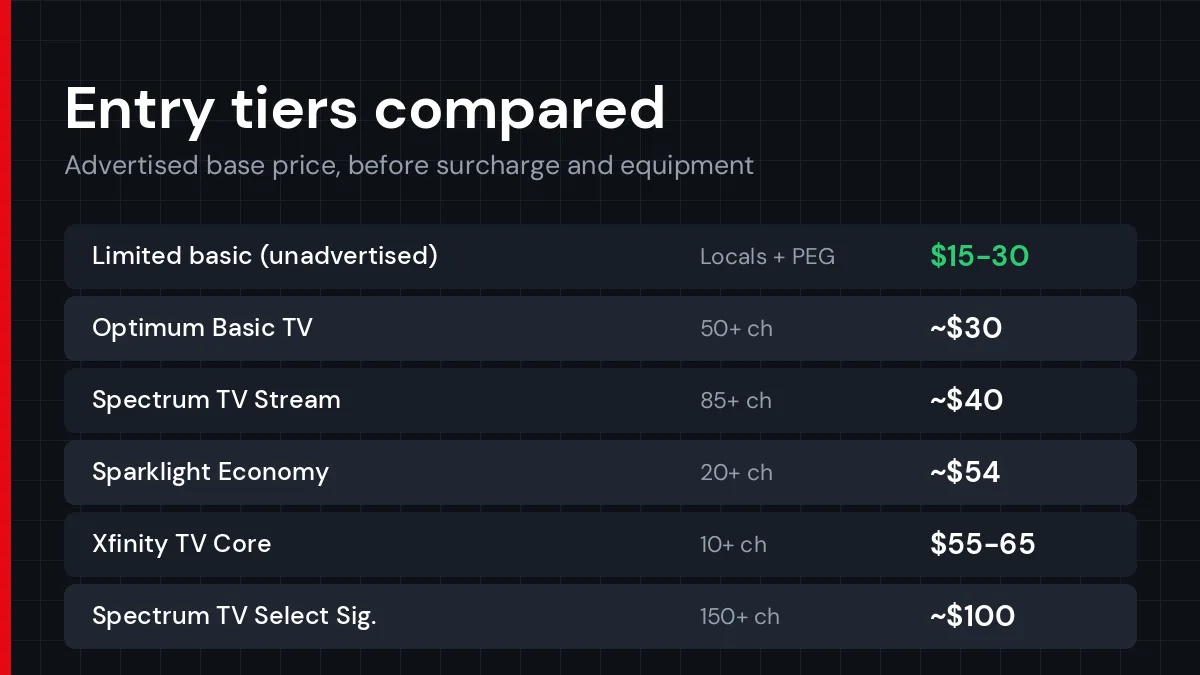
Two things stand out. Xfinity asks $55 to $65 for roughly ten channels, which is more than some providers charge for fifty. And Spectrum’s cheapest real cable package costs about $100, while its streaming version of the same idea costs about $40 with no box to rent. The cost of basic cable now depends more on how the signal is delivered than on how many channels arrive.
Why does the same tier cost more at your address?
Three local variables move the basic cable price street by street. Franchise fees are set by your municipality, regional sports fees are set by which teams your market carries, and competition does the rest. An address with a fiber rival nearby is quoted differently from one without.
This is also why comparison articles cannot give you a real number, including this one. A tier advertised nationally at $30 can land at $38 in one county and $52 in the next, with the same channel lineup. The only figure that counts is the all-in quote for your own address, which is why step two below matters more than any table.
Which fees turn a $30 package into a $60 bill?
Four of them, and only one is a tax. The broadcast TV surcharge is the big one, commonly $21 to $27 a month in 2026. Then equipment rental, a regional sports fee on anything above the basic tier, and local taxes. None of these are included in the price you were quoted.
- Broadcast TV surcharge: roughly $21 to $27 a month, and it sits outside promotional pricing, so it rises even on a locked rate
- Equipment rental: $8 to $15 per box per month, on hardware the company paid for years ago
- Regional sports fee: applies once you go above basic, whether or not you watch a single game
- Taxes and franchise fees: small individually, and they compound with everything above
The awkward part in 2026 is that some providers stopped itemising these. Xfinity moved to all-inclusive TV packages early in the year, which reads as simpler and makes the annual increase much harder to spot. A single number that goes up $8 attracts less attention than a fee line that goes up $8.
If your provider still itemises, the lines to find are labelled broadcast TV surcharge, regional sports network fee, and equipment or set-top rental. Add those three to the package price before you compare anything. That total is the only number worth putting next to a competitor quote, and it is the one nobody puts in an advert.
If you want the full picture of where a modern bill goes, our breakdown of how much cable costs walks through the whole statement rather than the entry tier alone.
How do you get the lowest basic cable price?
Call rather than order online, ask for the tier by its legal name, and refuse the equipment you do not need. Most of the saving comes from those three moves. The rest comes from knowing your promotional end date before the provider does anything about it.
- Ask for the basic service tier by nameNot the cheapest package, not a better deal. Say basic service tier or limited basic. The phrasing signals that you know it has to exist.
- Get the all-in monthly price in writingAsk what the total is with the broadcast surcharge, equipment and taxes included, then ask what it becomes when the promotion ends. Two numbers, both before you agree.
- Cut the boxesOne box per television at $8 to $15 a month adds up fast. Many providers support their own app on a smart TV, which removes the rental entirely.
- Check what an antenna gets you firstIf you only want locals, a $25 antenna delivers the same stations the basic tier is legally required to carry, permanently and free.
- Diary the promo expirySet a reminder for one month before it ends. The reset from a promotional rate to standard pricing is the single largest jump most households ever see on a TV bill.
- Re-price every twelve monthsPrices for cable and satellite typically rise between September and December. A yearly call, timed before that window, is worth more than any one-off negotiation.
What to say when they push a bigger package
The upsell is scripted, so it helps to have three answers ready. When you are told the cheap tier is being discontinued, ask whether the basic service tier is still offered, because the requirement to carry it does not disappear when a package is renamed.
When you are told a premium channel needs the mid package, ask for it individually. When you are offered a promotional bundle that costs less than basic for twelve months, ask what the standard rate is afterwards, then decide against that number rather than the promo. Most people accept the bundle, forget the reset, and end up paying full package pricing for a service they only wanted locals from.
None of this requires arguing. It requires knowing that limited basic exists and asking for it in plain words.
Why does basic cable cost more every year?
Programming and retransmission costs rise, and providers pass them through as fee increases rather than package price increases. Cable and satellite rates typically move between September and December, and the fee lines sit outside promotional pricing, so a locked rate protects you from less than it appears to.
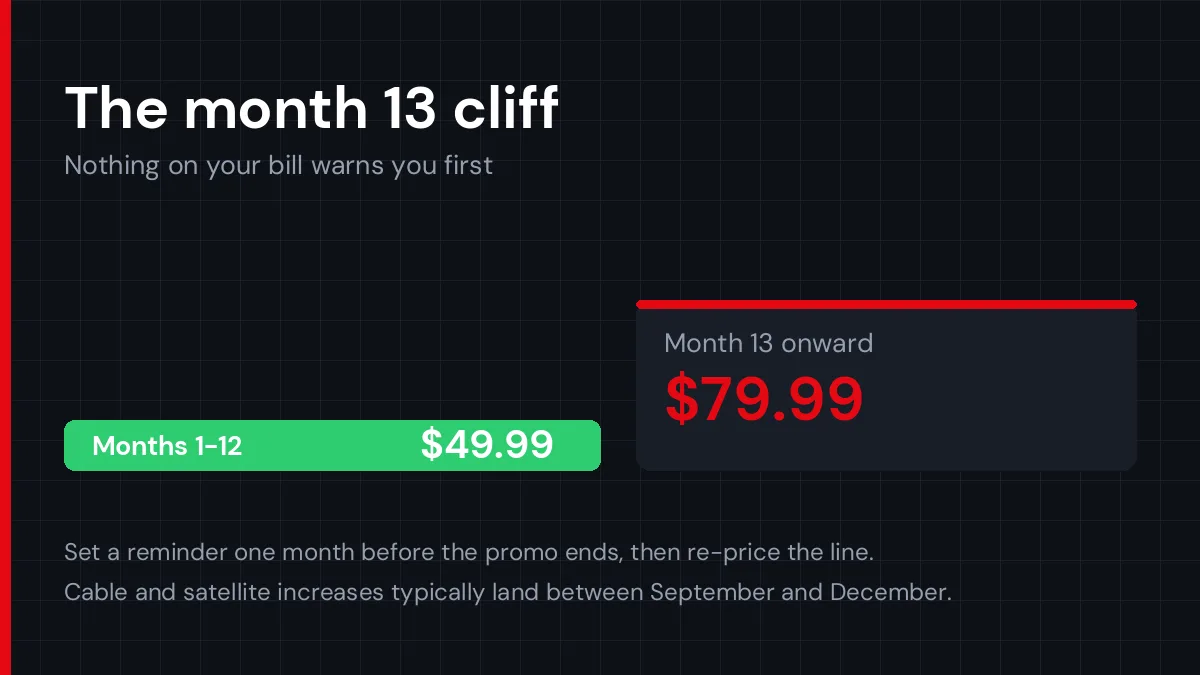
The sharper jump is the promotional reset. A rate advertised at $49.99 commonly returns to $79.99 after twelve months, and nothing on the bill announces it in advance. That single event moves more households off cable than any price increase, mostly because it arrives as a surprise.
2026 added a wrinkle. Several providers folded fees into all-inclusive packages, which reads as simplification and makes the annual rise much harder to notice. One number moving up $8 draws less attention than a surcharge line moving up $8, even though the outcome is identical. If you want to know how much is basic cable really costing you year over year, keep last August’s statement and compare the all-in totals rather than the headline prices.
Is basic cable still worth it in 2026?
For local news and network TV on one remote, the limited tier at $20 to $30 is defensible. For anything beyond that, the maths falls apart quickly, because the moment you want sports or entertainment channels you are pushed into a package that costs three to five times more and carries the regional sports fee with it.
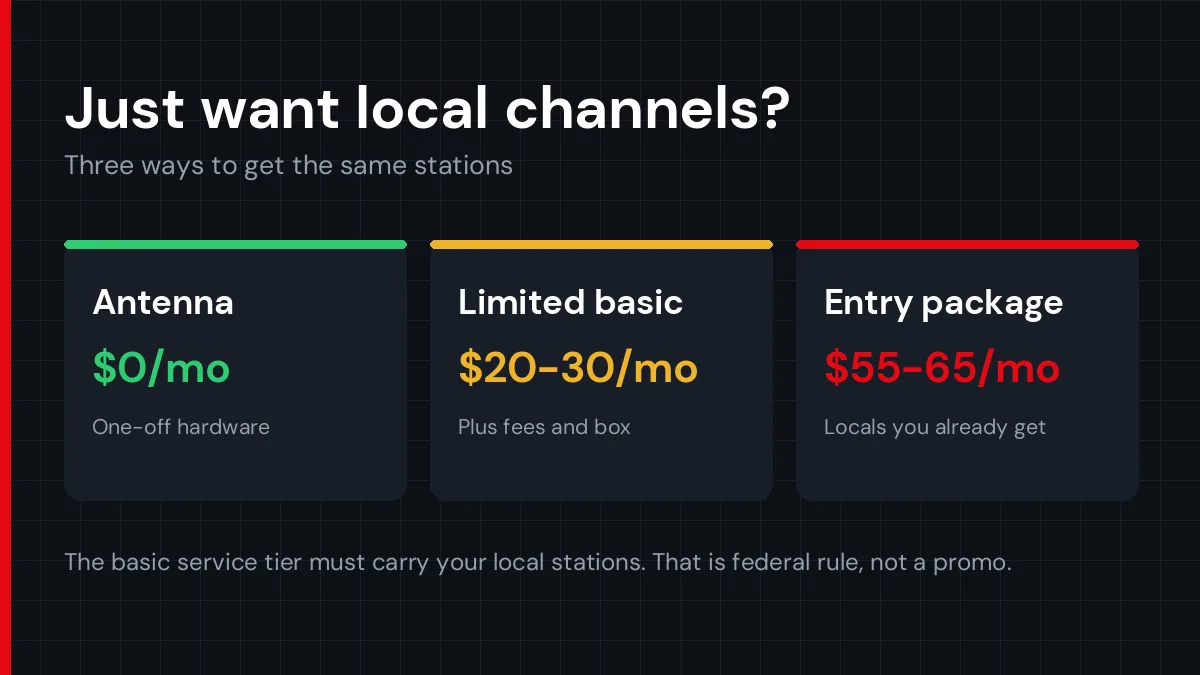
An antenna beats basic cable outright if reception at your address is good. Free ad-supported services cover a surprising amount of the filler that people think they are paying for. What neither replaces is live sport and a full channel grid, which is the actual reason most households stay on cable at all.
Run it over five years before deciding. A $30 limited tier with fees sits near $3,600 across five years. An entry package at $60 with the same fees lands closer to $6,000, and a full package sits above $9,000. Those are the numbers people never calculate, and they are the reason the basic cable price question is worth twenty minutes on the phone.
That is the honest fork in the road. Either you genuinely only need locals, in which case stop paying for cable entirely, or you want the full grid, in which case the question becomes what the full grid should cost. Our IPTV versus cable comparison runs those numbers side by side, and the guide to cutting the cord covers the cancellation itself.
Basic cable cost: quick answers to common questions
How much is basic cable with Comcast?
Xfinity’s entry TV package, TV Core, was advertised between $55 and $65 a month in August 2026 for around ten channels, with the lower figure usually requiring an internet bundle. The unadvertised limited basic tier is cheaper, but you generally have to phone and ask for it by name.
Is there a cheap basic cable option with only local channels?
Yes. Nearly every cable operator is required to sell a basic service tier carrying local broadcast stations and PEG channels, commonly $15 to $30 a month. It rarely appears on the website. Call and ask for limited basic or broadcast basic rather than the cheapest package.
How much is basic cable and internet together?
Bundles usually shave $10 to $20 off the TV side, and providers often quote the discounted TV price only when internet is attached. Compare the all-in bundle total against internet alone plus an antenna before assuming the bundle saves money, because it frequently does not.
Does basic cable include local channels?
Yes, by law. The basic service tier has to carry most local broadcast stations along with the public, educational and government channels in the operator’s franchise agreement. That requirement is exactly why the tier exists at every cable company in the country.
Why is my basic cable bill higher than the price I was quoted?
The broadcast TV surcharge, box rental and taxes are added after the advertised price, which together commonly run $25 to $40 a month. The surcharge in particular sits outside promotional pricing, so it can rise while your locked rate technically stays the same.
Can I get basic cable without internet?
Usually yes, as a standalone TV service, though the price is often worse than the bundled version because providers reserve the discount for multi-product customers. Ask for the standalone figure and the bundled figure, then compare both against dropping TV altogether.
Is basic cable cheaper than streaming?
For locals only, an antenna beats both. For a full channel grid, a live streaming package usually lands between the limited tier and a full cable package, with no equipment rental. The comparison only works once you count fees, which is where cable loses most of its apparent advantage.
What is the difference between broadcast basic and expanded basic?
Broadcast basic is the limited tier with local stations and PEG channels, and it is the one operators have to offer. Expanded basic is the step above, where cable networks such as ESPN and Discovery appear, and its price is set freely by the operator. Most people who say basic cable actually mean expanded basic.
Is the basic cable price regulated?
In limited circumstances only. Your local franchising authority can review basic service tier rate increases, but generally just where the operator faces no effective competition, and few authorities still do it. Treat the protection as the tier having to exist, not as a cap on what it costs.
Basic cable cost in 2026: the short version
Two numbers matter. The tier your provider has to offer costs $20 to $30, and the one it wants to sell you costs $55 to $65 before roughly $25 to $40 of fees. Ask for the first by name, get the all-in figure in writing, and set a reminder for the day the promotion ends.
If you are working out whether to keep any of it, the full cable cost breakdown and our guide to IPTV in the USA cover what the alternative actually costs per month.
Thirty thousand live channels for the price of a basic cable box rental. Test it free before you cancel anything.
Start Your Free Trial